
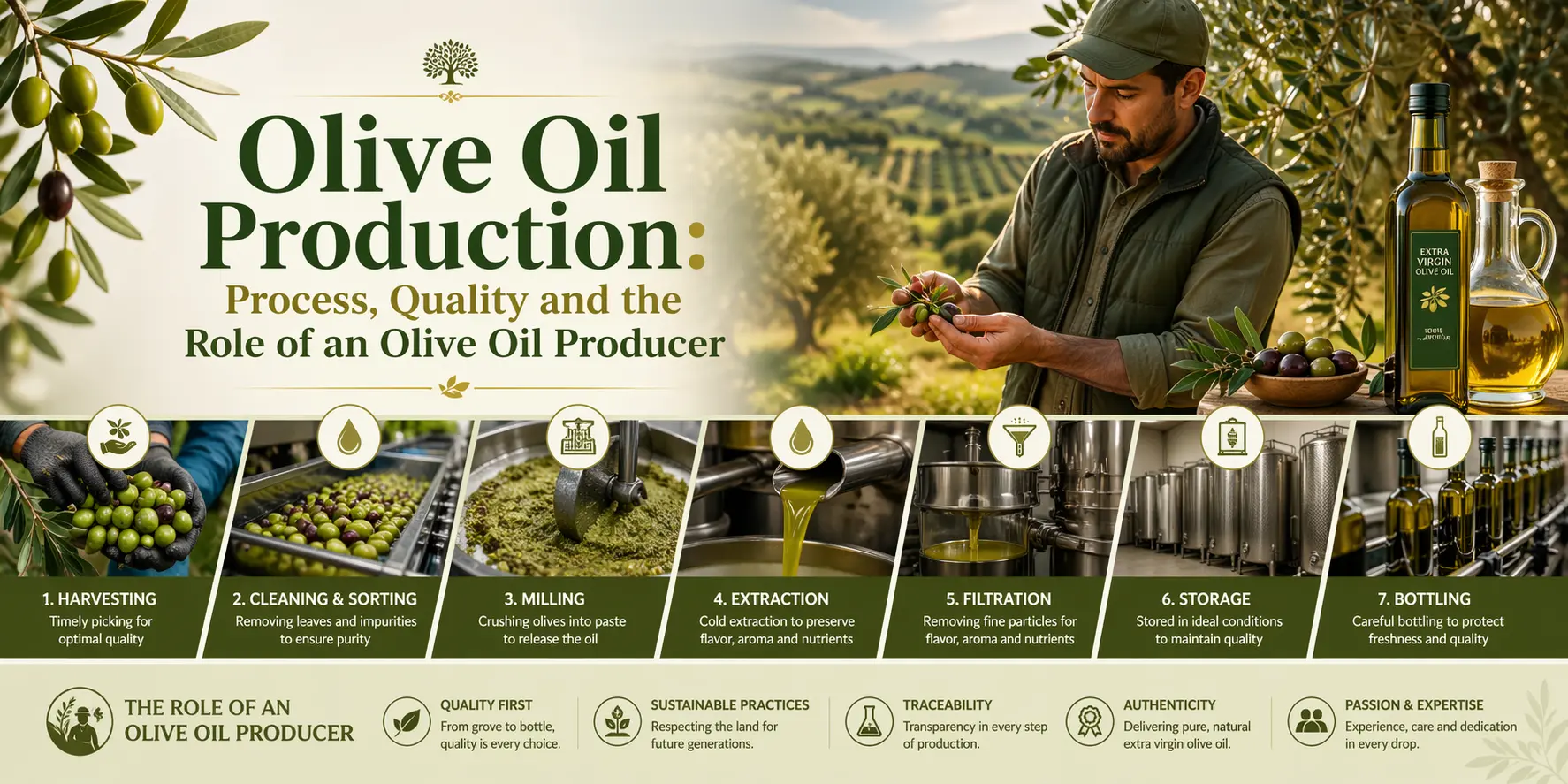
Production of olive oil is a well controlled process through which fresh olives are converted into a natural and healthy cooking oil. With the increased number of individuals shifting to healthier food options, olive oil now forms a significant role in everyday recipes. Knowing the process of olive oil production will guide in selecting an appropriate product in terms of health and flavor. A good olive oil producer will make sure that each of the steps is done in a correct manner so that the oil is not mixed and is full of nutrients.
Countries such as Turkey have developed a good image in the production of olive oil. To ensure uniformity, their producers integrate traditional knowledge with modern systems. From the time when the olives are picked up to the last stage of packing, each one of the steps is aimed at preserving the natural qualities of the oil.
What is the production of Olive oil?
Olive oil manufacturing is the process of obtaining oil out of the olives through mechanical means. The intention is to preserve the oil in its natural state without artificial chemicals and high temperatures. This will maintain the initial taste, aroma and nutrients.
A professional producer of olive oil is concerned with the quality at all levels. Olives are perishable, the time at which they are harvested, the way in which they are extracted influences the end result. Even minor delays may decrease the quality of the oil. That is why experienced producers make sure that the process starts immediately after harvesting.
Harvesting of Olives
The manufacturing of their olives starts with the harvesting of fresh olives. This is one of the most significant steps as the quality of the olives has a direct impact on the oil. Olives are picked either by hand or with the help of machines. The time of harvest is an important factor. Early harvesting yields oil rich in antioxidants and with more flavour. Late harvesting yields higher amount of oil but has lower intensity. Depending on the quality preferred, a reputable olive oil producer will decide on the appropriate time.
Cleaning and Preparation
After harvesting, the olives are taken to the production facility. They are washed to get rid of leaves, dust and other pollutants. This is done to maintain hygiene and enhance the quality of the end oil. Careful washing is done to ensure that there is no damage to the olives. Olives are then washed and undergo the following processing. To prevent any loss of freshness, a good olive oil producer will make sure that this step is done as soon as possible.
Paste and Crushing
The olives are washed, then crushed to produce a paste. This is done to break up the fruit and the oil inside is released. Uniform crushing is achieved by the use of modern machines. This is aimed at producing smooth paste that is easy to process. Crushing is a critical process since it has a direct influence on the quantity of oil recovered and the quality of the oil. The process is controlled, and uniform, through a competent olive oil producer.
Malaxation Process
Malaxation is a slow mixing of the olive paste after crushing. This enables the small droplets of oil to merge to form bigger oil droplets that are easy to extract. The temperature at this stage is highly significant. The surplus of heat may degrade the nutrients and lower quality. The natural aroma and flavour of the oil is maintained by controlled mixing.
Filtration and Storage
After extraction the oil is left to settle thus letting natural separation of impurities take place. It is filtered then to enhance clarity and shelf life. To ensure quality, appropriate storage is needed. Stainless steel containers are used to store olive oil under controlled temperature. It is not exposed to light, heat and air because it can diminish freshness.
Packaging and Distribution
Packaging is the last phase of the production of olive oil. The oil is packed into adequate containers like dark glass bottles or metal cans. These are anti-light and anti-oxidation oil materials. Packaging is done in hygienic conditions to ensure safety. The oil is packed and is now available to be distributed to various markets. A trusted producer of olive oil will make sure that the product will reach the customers without any deterioration in quality.
Job of an Olive Oil Producer
One of the key participants in the whole process is an olive oil producer. They are not only involved in production but also in quality control, storage and delivery. An excellent producer makes sure that the fresh olives are consumed and processed as soon as possible. They take advantage of modern equipment to ensure uniformity. They also adhere to the international standards to help them in making sure that the oil is safe to be consumed.
The Quality Factors of Olive Oil
The quality of olive oil depends on a number of factors. The most important is the freshness of olives. Late processing may result in fermentation, which impacts taste. The extraction temperature is also important. Cold extraction assists in preservation of nutrients and natural flavour. The conditions of storage are also crucial. Shelf life may be decreased by exposure to heat and light.
Olives Oil types produced
Different types of oil are produced based on quality and processing of olive oil production. The best quality is extra virgin olive oil. It is produced without additives and is very tasty. The virgin olive oil is a little less good but is natural. Refined olive oil is further refined and can be used in normal cooking. The different types have varying purposes in their usage
Increased Demand on Olive Oil
All over the world, the demand of olive oil is on the rise. There is an increased awareness of healthy eating habits. Olive oil is perceived to be a superior alternative to most of the conventional oils. In places such as India, urban families and restaurants are on the forefront of this change. Their favorite oils should be natural and healthy. This has heightened the need to have quality producers of olive oils that will provide constant quality.
Final Thoughts
Production of olive oil is a process requiring a lot of care in each stage. The harvesting up to packaging is towards quality maintenance. A reputable olive oil manufacturer will make sure that the oil is clean, fresh and healthy. Olive oil can be an important component of a healthy lifestyle with the correct production techniques and storage.
Read More – Olive Oil 2026: Benefits, Uses and How to Choose the Best Olive Oil