
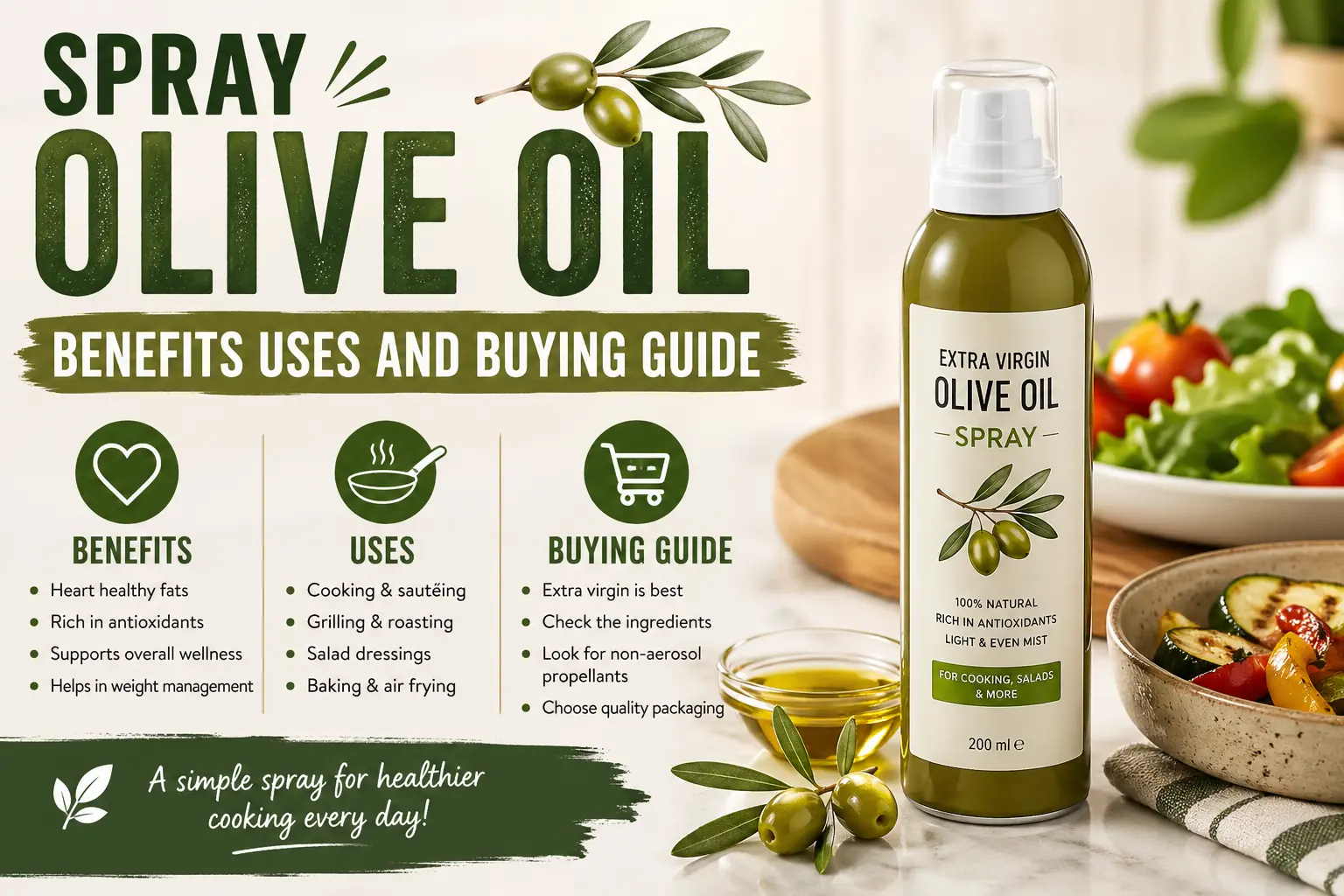
Spray olive oil is emerging as a smart alternative to modern kitchens. It assists individuals in using less oil and still has good taste. India is seeing a rapid change towards healthier cooking in many households. Olive oil cooking spray provides ease and regulation in everyday food. By selecting a reliable brand, one will have quality and safe usage. What is Spray Olive Oil? Spray olive oil refers to olive oil that has been stuffed in a spray can. It enables you to spray oil in fine spray. This is to aid in the utilization of less oil than pouring it. The oil is natural and does not lose its nutrients. Olive oil cooking spray is convenient and saves on the amount of oil used. It is recommended to those who desire a balanced diet. The Process of Making Spray Olive Oil? Olive oil is a high quality oil that is used to make spray olive oil. The oil is emptied into specially made spray containers. Such bottles make the release of oil smooth. Certain sprays are air pressure sprays that produce a fine mist. The oil content is untouched and not poisonous. Good manufacturing practices are such that the oil retains its natural properties. Types of Cooking Spray Olive Oil Spray olive oil is available in various types. Others are made of extra virgin olive oil. These are healthier and tastier. Others are smoothed to a greater heat. There are those sprays that are mixed to be used in particular purposes such as baking or grilling. The selection of the appropriate type will determine what you want to cook. Benefits of Spray Olive Oil Spray olive oil aids in healthy cooking. It assists in lowering calorie consumption since less oil is consumed. It has beneficial fats that help in keeping the heart healthy. It also contains antioxidants that defend the body. Olive oil is a cooking spray that can be used to control weight. It aids the digestive system, but in moderation. Uses of Spray Olive Oil Spray olive oil is very versatile. It may be applied to grease the baking trays and pans. It can be used in grilling and roasting vegetables. It can be used to give light dressing on salads. It aids in frying with little oil. Cooking oil olive is an ideal cooking oil that can be used daily without the overuse of oils. Read More – Organic Olive Oil: Benefits Uses and Buying Guide How to Choose the Best Spray Olive Oil? Always look at the label prior to purchase. Seek pure content of olive oil. Do not use products that have unnecessary additives. Select a reputable brand to have a high quality. Look at the packaging and expiry date. An excellent cooking spray olive oil must be able to spray well and maintain quality. Storage Tips for Spray Olive Oil Store the spray bottle in a cool and dry place. Store it out of the sun. The quality of oil can be influenced by heat. Always ensure that you close the cap after use. Keep the bottle out of high temperatures. Freshness is preserved with proper storage. Why is Quality important in Spray Olive Oil? Quality plays an important part in spraying olive oil. Poor quality products can have additives. Purity and safety of a good product. Spray olive oil of high quality is tastier and healthier. Always select a reliable source to use on a daily basis. Spray Olive Oil in India Spray olive oil is becoming popular in India. There is an increasing health consciousness among people. It is widely used in urban kitchens. People who are fitness conscious will use it to do controlled cooking. Demand is on the rise with a growing number of people living healthy lifestyles. Mostly Made Errors when using spray olive oil A typical error is the excessive spraying of oil. Moderation should be applied with even spray oil. The other error is to use it proxim to heat sources. This has the potential of breaking down the spray mechanism. Failure to check ingredients is a blunder as well. Always select a good quality cooking spray, olive oil. FAQs Q1. Does spray olive oil contain fewer calories than oil? Yes, spray olive oil can be healthier as it helps in controlling the amount of oil used. It lowers the amount of calorie consumption but still has the same benefits as olive oil. Q2. Is it possible to cook using spray olive oil? Yes, it is suitable for light cooking, baking and grilling. It can also be used to air fry and grease pans. Q3. Are there any chemicals in spray olive oil? Spray olive oil of good quality is free of harmful chemicals. Always read the label and select familiar brands. Q4. Is olive oil sprayed as a good weight-managing food? Yes, it assists in cutting the oil consumption that aids in managing weight with a balanced diet. Q5. Can spray olive oil be used for air fryers? Yes, spray olive oil is ideal for air fryers. It helps in applying a light and even layer of oil on food. This improves texture and crispiness without using excess oil. It is commonly used for fries, vegetables and snacks. Using cooking spray olive oil in air fryers supports healthier cooking and better results. Q6. Does spray olive oil affect the taste of food? Spray olive oil adds a light and natural flavour to food. Since it is used in small amounts, it does not overpower the dish. It enhances the taste while keeping it balanced. Cooking spray olive oil is suitable for salads, grilled items and baked foods where mild flavour is preferred. Final Thoughts Spray olive oil is an easy and convenient alternative to cooking in modern times. It assists in keeping a healthy lifestyle through the decreasing amount of oil consumption. It is important to select the appropriate product. A decent cooking spray olive oil is more convenient, controllable and healthier. It may
Olive Oil Production: Process, Quality and the Role of an Olive Oil Producer
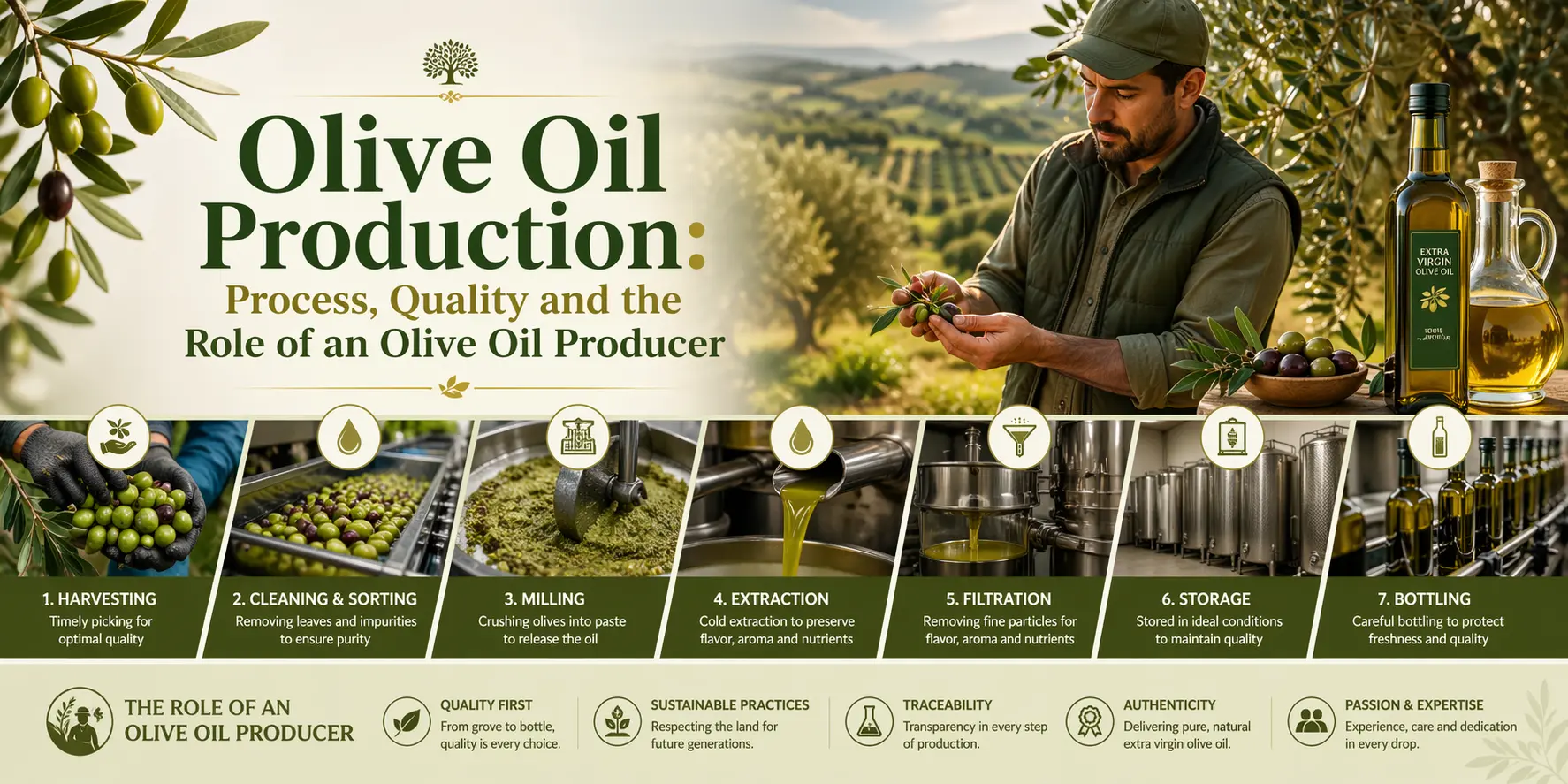
Production of olive oil is a well controlled process through which fresh olives are converted into a natural and healthy cooking oil. With the increased number of individuals shifting to healthier food options, olive oil now forms a significant role in everyday recipes. Knowing the process of olive oil production will guide in selecting an appropriate product in terms of health and flavor. A good olive oil producer will make sure that each of the steps is done in a correct manner so that the oil is not mixed and is full of nutrients. Countries such as Turkey have developed a good image in the production of olive oil. To ensure uniformity, their producers integrate traditional knowledge with modern systems. From the time when the olives are picked up to the last stage of packing, each one of the steps is aimed at preserving the natural qualities of the oil. What is the production of Olive oil? Olive oil manufacturing is the process of obtaining oil out of the olives through mechanical means. The intention is to preserve the oil in its natural state without artificial chemicals and high temperatures. This will maintain the initial taste, aroma and nutrients. A professional producer of olive oil is concerned with the quality at all levels. Olives are perishable, the time at which they are harvested, the way in which they are extracted influences the end result. Even minor delays may decrease the quality of the oil. That is why experienced producers make sure that the process starts immediately after harvesting. Harvesting of Olives The manufacturing of their olives starts with the harvesting of fresh olives. This is one of the most significant steps as the quality of the olives has a direct impact on the oil. Olives are picked either by hand or with the help of machines. The time of harvest is an important factor. Early harvesting yields oil rich in antioxidants and with more flavour. Late harvesting yields higher amount of oil but has lower intensity. Depending on the quality preferred, a reputable olive oil producer will decide on the appropriate time. Cleaning and Preparation After harvesting, the olives are taken to the production facility. They are washed to get rid of leaves, dust and other pollutants. This is done to maintain hygiene and enhance the quality of the end oil. Careful washing is done to ensure that there is no damage to the olives. Olives are then washed and undergo the following processing. To prevent any loss of freshness, a good olive oil producer will make sure that this step is done as soon as possible. Paste and Crushing The olives are washed, then crushed to produce a paste. This is done to break up the fruit and the oil inside is released. Uniform crushing is achieved by the use of modern machines. This is aimed at producing smooth paste that is easy to process. Crushing is a critical process since it has a direct influence on the quantity of oil recovered and the quality of the oil. The process is controlled, and uniform, through a competent olive oil producer. Malaxation Process Malaxation is a slow mixing of the olive paste after crushing. This enables the small droplets of oil to merge to form bigger oil droplets that are easy to extract. The temperature at this stage is highly significant. The surplus of heat may degrade the nutrients and lower quality. The natural aroma and flavour of the oil is maintained by controlled mixing. Filtration and Storage After extraction the oil is left to settle thus letting natural separation of impurities take place. It is filtered then to enhance clarity and shelf life. To ensure quality, appropriate storage is needed. Stainless steel containers are used to store olive oil under controlled temperature. It is not exposed to light, heat and air because it can diminish freshness. Packaging and Distribution Packaging is the last phase of the production of olive oil. The oil is packed into adequate containers like dark glass bottles or metal cans. These are anti-light and anti-oxidation oil materials. Packaging is done in hygienic conditions to ensure safety. The oil is packed and is now available to be distributed to various markets. A trusted producer of olive oil will make sure that the product will reach the customers without any deterioration in quality. Job of an Olive Oil Producer One of the key participants in the whole process is an olive oil producer. They are not only involved in production but also in quality control, storage and delivery. An excellent producer makes sure that the fresh olives are consumed and processed as soon as possible. They take advantage of modern equipment to ensure uniformity. They also adhere to the international standards to help them in making sure that the oil is safe to be consumed. The Quality Factors of Olive Oil The quality of olive oil depends on a number of factors. The most important is the freshness of olives. Late processing may result in fermentation, which impacts taste. The extraction temperature is also important. Cold extraction assists in preservation of nutrients and natural flavour. The conditions of storage are also crucial. Shelf life may be decreased by exposure to heat and light. Olives Oil types produced Different types of oil are produced based on quality and processing of olive oil production. The best quality is extra virgin olive oil. It is produced without additives and is very tasty. The virgin olive oil is a little less good but is natural. Refined olive oil is further refined and can be used in normal cooking. The different types have varying purposes in their usage Increased Demand on Olive Oil All over the world, the demand of olive oil is on the rise. There is an increased awareness of healthy eating habits. Olive oil is perceived to be a superior alternative to most of the conventional oils. In places such as India, urban families and restaurants are on
Olive Oil 2026: Benefits, Uses and How to Choose the Best Olive Oil
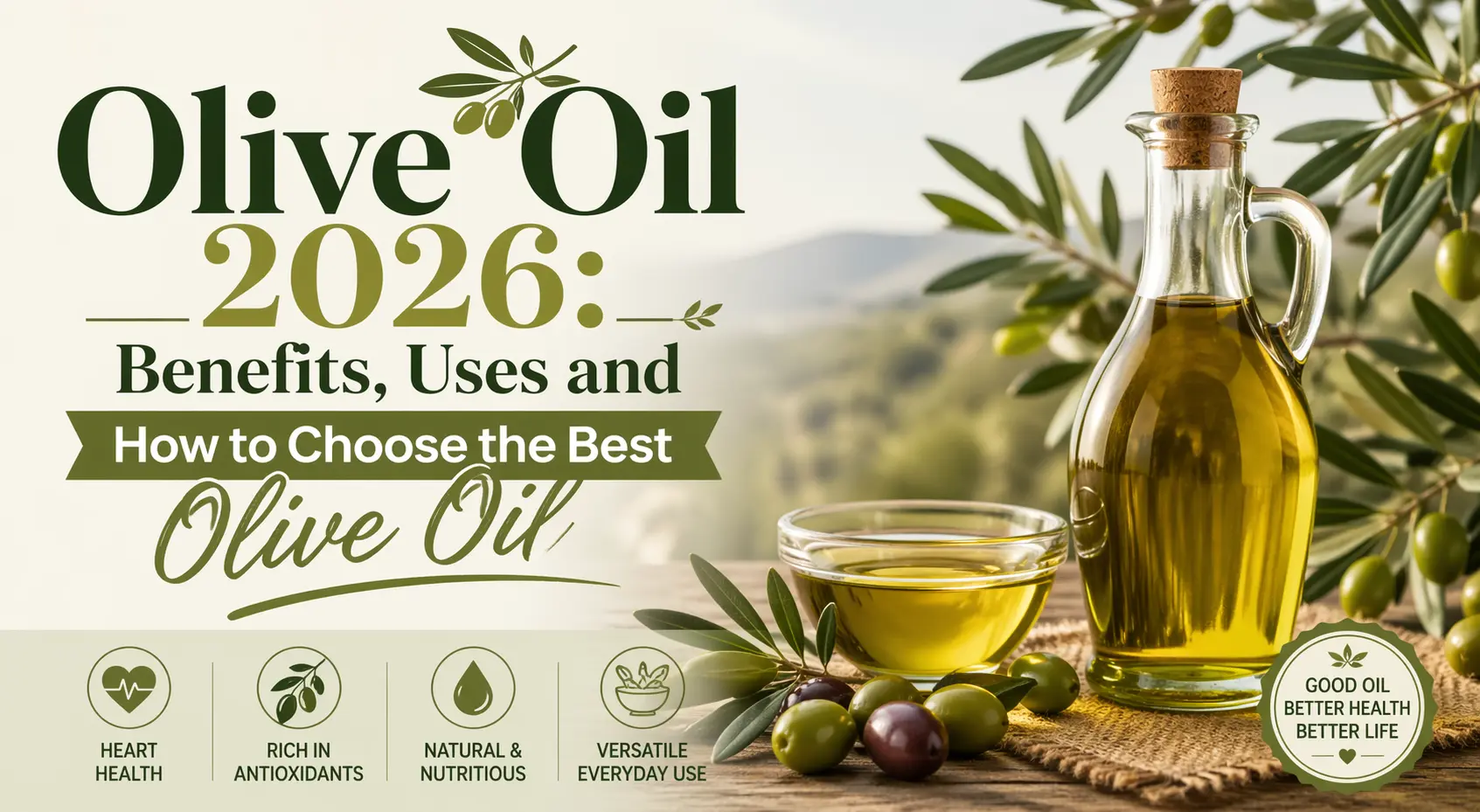
Olive oil has been a wildly popular cooking oil in the globe, particularly among individuals who are conscious about health and nutrition. The demand for olive oil will keep on increasing in 2026 as more households and businesses move towards the consumption of natural and minimally processed food products. Olive oil has become commonplace in contemporary kitchens thanks to its rich flavor and numerous health-promoting properties. Olive oil is becoming a preferred choice due to the growing concern on healthy fats. Olive oil is extracted through pressing of the olives unlike many other refined oils, this process is known to preserve the natural nutrients and flavour of the oil. This renders it more suitable both in cooking and on a daily basis and in the preparation of high quality food. What is Olive Oil? Olive oil is a natural oil produced by crushing olives, which are fruits cultivated in mostly Mediterranean areas. The oil is obtained by crushing and pressing the olives, without the need for chemical processing in high-quality varieties. It is extensively consumed in cooking, salad dressing, and even in skin care and wellness. Olive oil is characterized with a smooth texture and somewhat fruity flavor. Olive oil is composed of a large percentage of monounsaturated fats, which are said to be healthy to the body. Olive Oil in 2026: Growing Popularity By the year 2026, olive oil will no longer be restricted to the Mediterranean countries. It is now an international product and is used in India, United States and most of the Asian markets. This has been significantly contributed by the change towards healthier diets. Olive oil has been found to be more nutritious than the traditional cooking oils and people are now substituting them with olive oil. This change has also been affected by the popularity of diets such as the Mediterranean diet. Olive oil is currently being applied in making salads, even in normal cooking, baking, and even frying at controlled temperatures. Health Benefits of Olive Oil One of the primary factors that have led to the demand of olive oil all over the world is related to its strong health value. It has healthy monounsaturated fats that reduce bad cholesterol and heart health. It is also full of antioxidants which aid in the alleviation of inflammation and guarding the body against chronic illnesses. Frequent intake of olive oil has been associated with a better cardiovascular health and a greater overall wellbeing. 10 Proven Health Benefits of Extra Virgin Olive Oil Types of Olive Oil in Market Olive oil comes in various types with their own characteristics in the market. Extra virgin olive oil is the best and it is produced without the use of chemicals or heat. It retains maximum nutrients and has a rich flavour. Virgin olive oil is of slightly inferior quality but is nevertheless natural and can be used in light cooking. The refined olive oil is refined further and is usually utilized in ordinary cooking because of the lack of taste and increased smoke point. Which is the Best Olive Oil? The highest quality of olive oil is attributed to its purity, freshness, and mode of extraction. The cold-pressed oil is considered the best due to the fact that the nutrients and flavour are not lost. The origin of olives is also important. High quality and fresh olive yields better oil. A good producer will be one who will make sure that the olives are processed soon after picking so that they are not spoilt. Another such factor is packaging. To avoid being affected by light, olive oil should be stored in dark bottles. Storing it properly will ensure that it retains its quality. The most important factor in the best olive oil is consistency. One of the reasons is that a trusted brand guarantees that each lot will be the same in quality and taste. Uses of Olive Oil Olive oil is very versatile and is used in cooking. It is used traditionally in sautéing, grilling and making salads. It contributes to the natural flavour of food without dominating other food ingredients. Olive oil is also applied in skincare and hair care besides cooking. It plays the role of a natural moisturiser and is used in keeping the skin healthy. It is as well applied in traditional remedies and wellness practices. Its usefulness is due to the presence of antioxidants and vitamins which make it useful both internally and externally. How to Select the Best Olive Oil in 2026? When it comes to selecting the best olive oil a few factors have to be considered. Always make sure that you look at the label to see such terms as extra virgin and cold pressed. These indicate better quality. Search information on the source and mode of production. Clear sourcing and processing information is given in transparent brands. Another important factor is the freshness. Olive oil is best consumed when it is fresh and it is, therefore, crucial to pay attention to the production date. The packaging is also important, with dark bottles being useful to keep the oil. In 2026, consumers are becoming more conscious and picky. They like those brands which are quality oriented, sustainable and authentic. The reason why Olive Oil is a Smart Choice Olive oil is one of the healthiest cooking oils presently on the market. It is a combination of taste, nutrition and versatility and therefore can be used daily. As the awareness on lifestyle diseases grows, consumers are opting to use oils that will help them in the long-term. Olive oil can easily be included in such a strategy because of its natural form of composition and established advantages. It is also an adaptable product that can be utilized in various forms and this makes it an effective option to households and food industries alike. Conclusion In 2026, olive oil symbolizes a change to a healthy and conscious lifestyle. It is more than just a cooking oil. It is an element
High Quality Olive Oil and Flavoured Infused Olive Oil Producer Guide
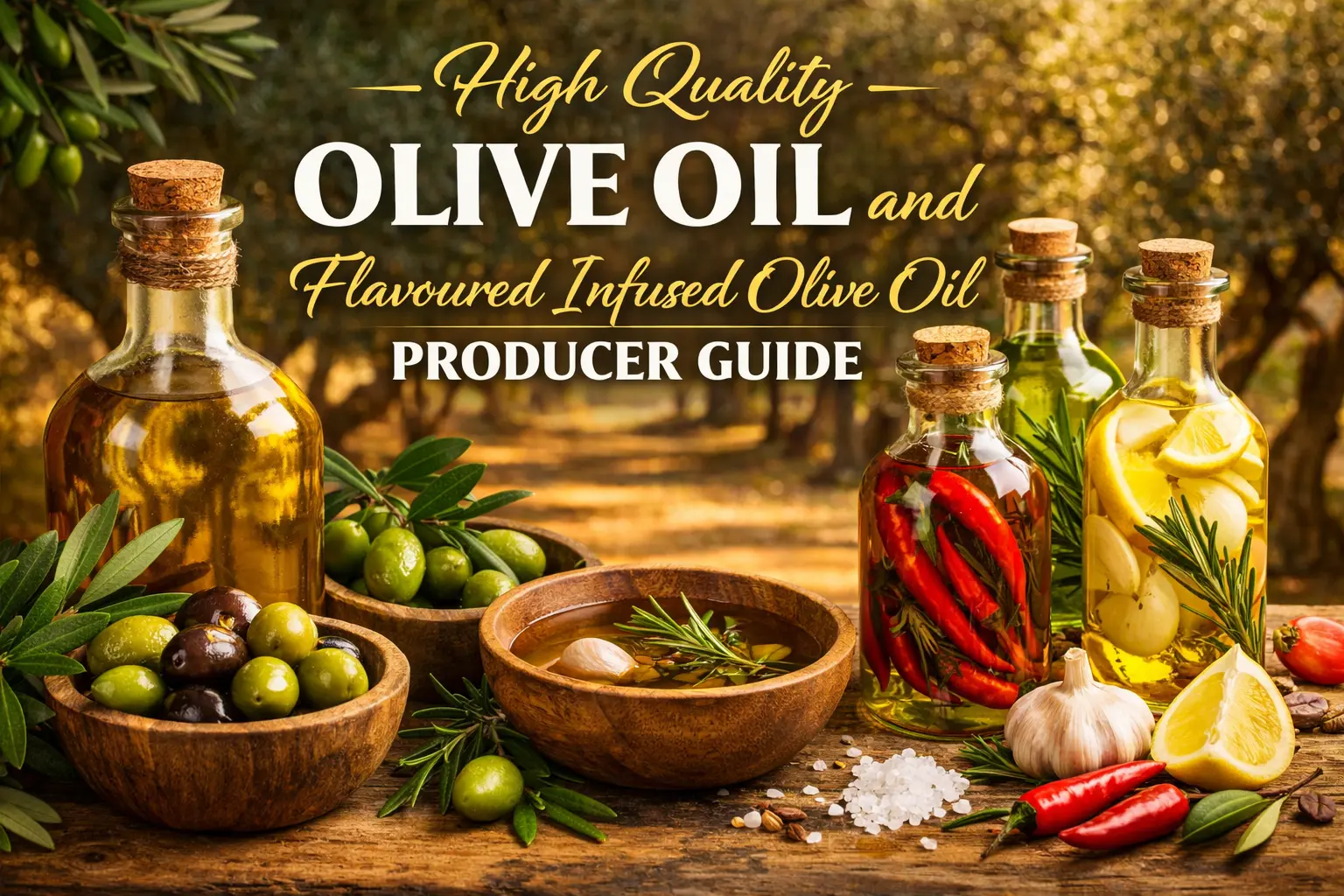
Good quality olive oil has been one of the important components of modern kitchens, particularly to those who appreciate health and flavor. As there is increased awareness with regard to nutrition, there is a shift towards natural oils that are not only beneficial but also tasty. One of the assuring flavoured infused olive oil manufacturers is the one who has not only pure oil but also abundant aroma and consistency in it. Consumers and businesses are equally interested today in high quality olive oil that complies with international quality standards. The Turkish people are famous olive producers and they boast some of the best producers. These manufacturers integrate the conventional techniques with contemporary technology to produce high quality olive oil and novel infused types that are appealing to the world. What is High Quality Olive Oil? Olive oil is produced in high quality by extracting fresh olives through meticulous procedures that do not affect the nutrients and natural flavour. It is normally cold-pressed meaning it is not extracted using heat or chemicals. This aids in preserving antioxidants and fatty acids. An infused olive oil manufacturer whose flavours are sure, is one that adheres to quality control measures. They are in the form of international standards like HACCP, ISO, HALAL and KOSHER certification. These requirements guarantee that the oil is safe, clean and fit to world consumption. What is Flavoured Infused Olive Oil? Flavoured infused olive oil is olive oil that has been enriched with natural flavours such as herbs, spices or citrus. They can be added to dishes to give them special flavours that can enhance daily cooking. A manufacturer of flavoured infused olive oil is a professional and balances ingredients carefully. Some of the most common infused flavours are garlic, lemon, chilli, rosemary and basil. These oils are popularly used in salads, marinades and fine cuisine. How High Quality Olive Oil is Produced? The process of production starts with picking of olives when they are in the proper stage of ripening. Premature harvesting assists in maintaining increased antioxidants. The olives are then washed to cleanse them. This is followed by crushing and pressing. Cold pressing is used to extract high quality olive oil, and it does not affect natural nutrients. Oil is filtered and kept in controlled conditions in order to keep it fresh. The Process of Making Flavoured Infused Olive Oil Infused olive oil is prepared through the addition of natural ingredients to base olive oil producing flavoured infused oil. The infusion is carried out meticulously so as to prevent contamination or an unequal distribution of flavour. There are manufacturers who employ slow infusion techniques and the herbs and spices release their essence slowly. Controlled methods are employed by other people in order to be consistent between batches. The end product is sieved and filled in airtight containers. A reputable flavoured infused olive oil manufacturer will guarantee the flavour and shelf life of the oil. Quality in the production of olive oils One of the most critical issues of the production of olive oil is maintaining quality. The best manufacturers have stringent quality control measures. These systems encompass all the procedures including farming and packaging. ISO and HACCP certifications also guarantee that the oil is safe according to the international standards. These standards are also concerned with hygiene, traceability and consistency. Another laboratory testing is done by the producers to determine the level of acidity and purity. You can learn more about how our olive oil factory meets international export standards in detail. High Quality Olive Oil Features Olive oil can be characterized in terms of quality based on its aroma, taste and texture. It is frequently fresh and fruity smelling like green apples, almonds, or herbs. The flavor might contain a touch of bitter and peppery aftertaste. It is an indicator of a high level of antioxidants. The texture is even, smooth and rich, which makes it good to cook with, as well as to use raw. Read more about the characteristics that distinguish the top olive oil from the rest. Benefits of Olive Oil Olive oil is of high quality and has a number of health benefits. It has good fats that are healthy to the heart. It also contains antioxidants, which aid in debasing inflammation. Learn more about the 10 proven health benefits of extra virgin olive oil. The frequent intake of olive oil can facilitate digestion and enhance body health. It is also reputed to have skincare benefits as it is a natural moisturiser. Uses of Flavoured Infused Olive Oil Modern cooking heavily depends on flavoured infused olive oil. It provides flavor and aroma without the additional substances. It is ideal to use as salad dressing, pasta, grilled vegetables, and marinades. Explore the best ways to use olive oil in everyday cooking for more inspiration. Infused oil is commonly used by restaurants and chefs to prepare special dishes. It enhances presentation and flavour at the same time. Why Select a Relied Flavoured Infused Olive Oil Maker? The selection of the appropriate producer is critical in terms of quality and reliability. When a reliable virgin olive oil manufacturing company is involved, it will guarantee that the oil is produced using quality olives and natural ingredients. They also adhere to stringent quality checks and international benchmarks. This guarantees an oil that is safe, pure and consistent. Storage Ideas about Olive Oil Olive oil can be preserved by proper storage to uphold its quality. It is supposed to be stored in a cool and dark storage. Its freshness may be diminished by exposure to sunlight and heat. One should ensure that the bottle is tightly closed so as to avoid exposure to the air. Find out why glass is the best material for olive oil storage to preserve freshness. The use of the oil within the recommended time will guarantee maximum taste and quality. International Demand of Quality Olive Oil High quality olive oil is in demand around the world. There is increasing awareness among people
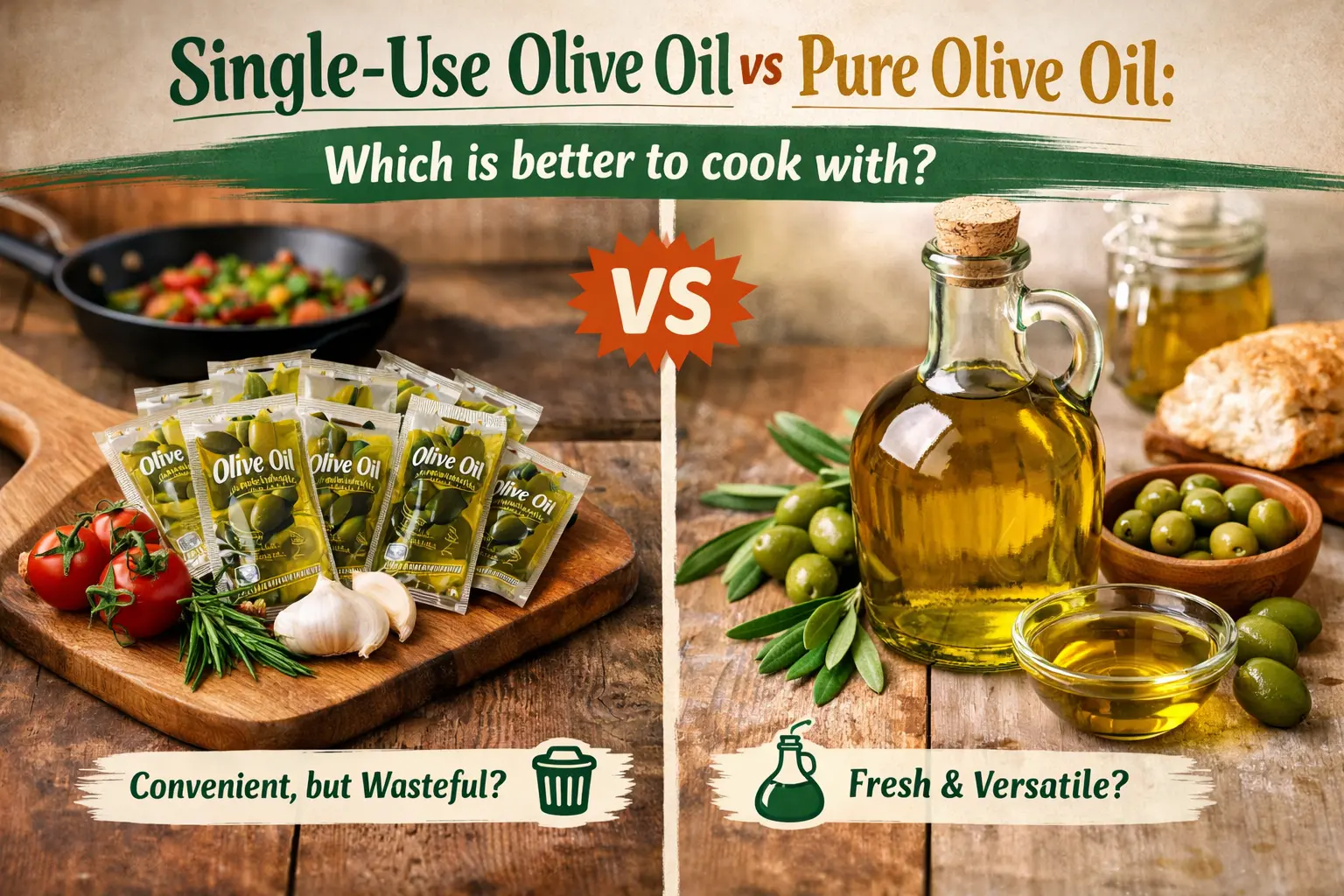
Single-Use Olive Oil vs Pure Olive Oil: Which is better to cook with?
When choosing olive oil to cook every day, a great number of consumers use single use olive oil and pure olive oil to comprehend which one is more pragmatic and advantageous. Both varieties are obtained out of olives though they vary in packaging, usage and cooking applications. Single use olive oil is normally packed in small sachets or mini boxes to be used once, whereas pure olive oil is packed in bottle form and it is normally used in normal cooking. Knowledge of the distinction between single use olive oil and pure olive oil will enable households, restaurants and food business make the best choice of the easiest and effective way to cook. What is Single Use Olive Oil? Single use olive oil is olive oil that is packed into small individual portions that are meant to be used once. These mini packs are mostly used in restaurants, airlines, caterings and take away food companies. The key benefit of the single use olive oil is convenience. As a pack has a fixed amount, it will prevent the waste and will guarantee the hygienic use. The features of Single Use Olive Oil. Stuffed in mini bottles or small sachets. Ideal for one-time usage Stays fresh due to the seal of the pack. Popular in hotels, restaurants and food delivery. Portable to go with or on the road. A lot of food companies obtain the products at an olive oil factory where the bulk production and hygienic packaging are taken care of. What is Pure Olive Oil? Refined olive oil mixed with a low percentage of virgin olive oil make up pure olive oil. It is mostly consumed in day-to-day cooking because of its balanced taste and average cost. Pure olive oil is also much milder than premium olive oils and has a higher smoke point, thus being used in sauteing, frying, and baking. Olive oil in its purest form is normally packaged in bigger bottles to be used at home or in a commercial kitchen. It is made and processed in a factory of oil that produces and mixes olives to attain a certain texture and taste. The main Characteristics of Pure Olive Oil. Mixed with pure and raw olive oil. Light taste apt to most cuisines. Increased cooking smoke point. Packaged in bottles or in bulk. Fits perfectly in a standard home cooking. Single Use Olive Oil vs. Pure Olive Oil. Feature Single Use Olive Oil Pure Olive Oil Packaging Small sachets or mini packs Bottles or large containers Usage One-time use Daily cooking oil Convenience Highly convenient and hygienic Suitable for regular kitchen use Cost Slightly higher per serving More economical for frequent cooking Storage No storage required after use Needs proper storage after opening Common Use Restaurants, catering, travel meals Household cooking and frying The producer of Olive oil in an Olive Oil factory. Single use olive oil and pure olive oil are both derived out of the processing of olives in a professional processing plant of olive oil. The procedure normally involves picking, washing, squashing and oil extraction of olives. Olive Oil Production Process Picking Olives – Fresh olive fruits are picked when they are of the appropriate maturity. Cleaning and Sorting – The olives are sprayed and the leaves or any impurities are removed. Crushing and Extraction – This is done by crushing of the olives to extract oil. Refining and Blending – With pure olive oil, the extract oil could be refined and mixed to have a stable product. Packaging – The oil is packed in bottles or single use sachets basing on the type of product. The current factories are hygienic, controlled, and better packaged to retain the freshness of products. Advantages of Single Use Olive Oil. The benefits of single use olive oil have a number of benefits, particularly in business settings. Key Benefits Increased hygiene: Every portion is closed and consumed once. Cosy pack: readily distributed in restaurants or travel meals. Portion control: It stops unnecessary use and less waste. Freshness: Each service is a freshly-opened service. Simple storage: It does not require one to worry about the presence of oil in the storage after opening the bottle. Single use olive oil is a convenient and effective solution to the needs of catering services and the take away food business. Benefits of Pure Olive Oil The natural olive oil is common in the household due to its versatility and balanced composition. Key Benefits Large quantities of pure olive oil are usually processed into an olive oil factory where the quality is consistent to cook daily. Which of the two is more suitable to cook? Whether to use single use olive oil or pure olive oil will depend on the way and the place of use. Single use olive oil is superior where: You require divinely sanitized portion control. You have a restaurant or catering business. You require a convenient package to carry or have a takeaway meal. Pure olive oil is better when: You cook regularly at home You require frying or sauteing oil. You like to purchase the olive oil in bigger bottles. Many food companies apply both alternatives: on the one hand, pure olive oil is used in kitchen cooking, and on the other hand, the use of single use olive oil to serve the customer. How to Select the Best Olive Oil. When purchasing olive oil, one should consider the following tips to make sure it is of good quality: Buy on a reputable olive oil factory or a licensed supplier. Test the date of packing and shelf life. Olive oil should be stored in a cool and dark environment in order to stay fresh. To prevent contamination, use closed packaging. The selection of the appropriate type of olive oil depends on the cooking demand. These few steps may assist you in preserving
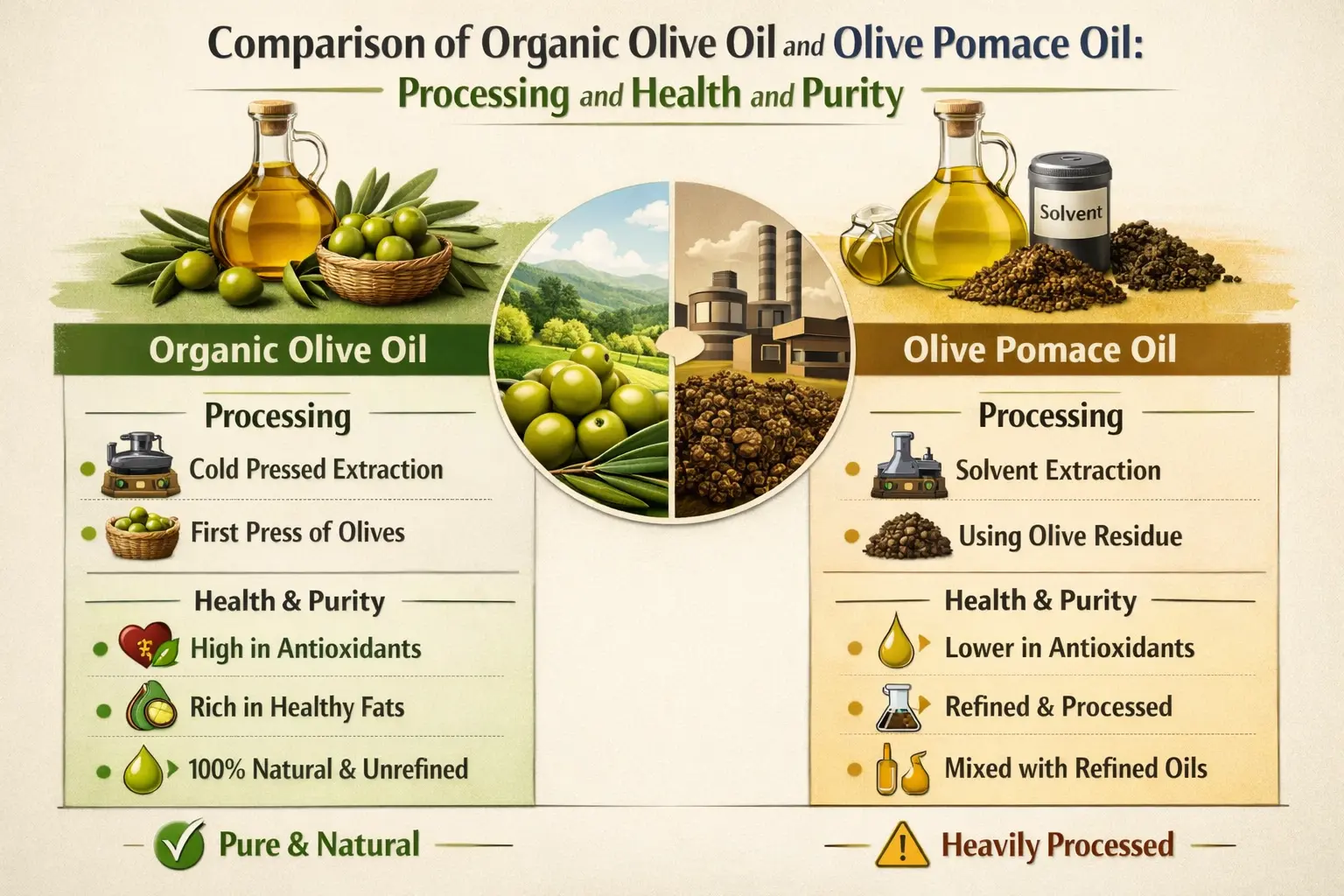
Comparison of Organic Olive Oil and Olive Pomace Oil: Processing and Health and Purity
Discriminating between organic olive oil and pomace olive oil is a common habit among many people when selecting the appropriate olive oil to cook and to have good health. The two types are both produced out of olives but differ greatly in terms of how they are processed, the level of purity and the nutritive quality. Organic oil is made by means of olives that are grown in an organic way and is not processed with the help of any additional chemicals whereas the pomace oil is made by means of the residual olive pulp with the help of further processing. Knowing the difference between organic olive oil and pomace products makes consumers make more choices in cooking, salad dressing and health in general. Here we shall discuss their purity, how they are produced, their uses and their benefits in order to make the right choice of olive oil in your kitchen. What is Organic Olive Oil? The production of organic olive oil involves the use of olives that have not been treated with chemical fertilizers and pesticide. The olives are naturally harvested and processed in certified plants in order to retain purity and quality. The oil is greatly appreciated due to its natural flavor, high nutritional value and the production process is chemical-free. Most consumers would like to shop with an Organic Olive Oil Supplier whom they can rely on and are aware of the high standards of the product. Quality suppliers tend to get their oil in certified farms and modern extracting plants. The major attributes of Organic Olive Oil * Made out of the organically grown olives. * No artificial chemicals and pesticides. * Low in fat and cholesterol, high in antioxidants. * Natural taste and aroma * Applicable in Salads and light cooking. Organic olive oil is usually prepared in an Organic Olive Oil Mill Company that makes use of stringent organic farming and extraction standards in order to ensure product purity. What is Olive Pomace Oil? The leftover olive pulp used to extract the first extraction of olive oil is used to make Pomace olive oil. There is still a very small portion of oil in this pulp that is recovered by heating and using safe solvents. The oil is refined, and it is lighter in taste and can be used in cooking at high temperatures. The reason why a lot of large-scale producers use pomace oil or an Olive Oil Mill Company uses the material is that it enables them to use the rest of the olive material effectively. Important Properties of Pomace Olive Oil * Derived out of residual olive pulp. * Cooking refined. * Tasteless versus organic olive oil. * Cheap relative to high quality olive oils. * Frying and deep cooking worthy. Pomace oil is commonly utilized as cooking dressing olive oil in restaurants and in commercial kitchens because it is cost effective and has a high smoke point. Organic Olive Oil vs PM Olive Oil. Feature Organic Olive Oil Pomace Olive Oil Source Organic olives grown without chemicals Residual olive pulp after first extraction Processing Mechanical extraction without chemicals Extracted using heat and refining methods Purity Highly pure and natural More refined and processed Flavor Rich, natural olive taste Mild and neutral flavor Nutritional Value High in antioxidants and nutrients Lower nutrients due to refining Best Use Salad dressing, light cooking Frying, roasting, high-heat cooking Price Usually more expensive More affordable This analogy gives a clear indication as to why a lot of health-sensitive people are more inclined to using organic olive oil, and many commercial foods are cooked using pomace oil. Processing Methods explained Production of Organic Olive Oil Production of organic olive oil begins with the production of olives which are organically grown and then harvested when they reach proper maturity. The olives are washed and crushed and the oil is squeezed out by use of mechanical means. A certified Organic Olive Oil Mill Company makes sure that no artificial chemicals are applied in the whole process. This process of natural extraction contributes to the preservation of nutrients, flavor and antioxidants of the oil. Pomace Olive Oil Production The pulp that is left after the initial pressing of olives is called pomace and has oil remaining. This pulp is refined in an Olive Oil Mill Company through advanced extraction procedures in order to get the rest of the oil. Refining of the oil is then done to eliminate the impurities and produce a stable cooking oil. Even though refined, the pomace olive oil has continued to be very popular in food preparation since it has a high smoke point. Health Benefits of Organic Olive Oil It has a number of health benefits due to the fact that organic olive oil is known to have natural nutrients and antioxidants. Key Benefits * Supports heart health * High monounsaturated fats. * It contains antioxidants that help in fighting inflammation. * Helps improve digestion * Healthy cooking and salads. Since it is less refined, organic olive oil has more abundant useful compounds in it than the refined oils. Pomace Olive Oil Benefits This notwithstanding the fact that pomace olive oil is refined, its usefulness in most kitchens is still evident. Common Benefits * Increased smoke point that can be used to fry. * I less expensive cooking oil alternative. * Light taste which mixes well with most of the dishes. * Cooking in high temperatures. * Commonly used in commercial kitchens. Pomace oil is also used by many restaurants as a cooking dressing olive oil since it can withstand repeated cooking in frying and sauteing. Which One Should You Choose? Whether to use organic olive oil or pomace olive oil depends on your intentions of using it. Choose organic olive oil if: * You are interested in maximum health benefits. * You are a person who likes natural and chemical-free products. * You are preparing it to use in salads, dips or light cooking. Choose pomace olive oil if: To
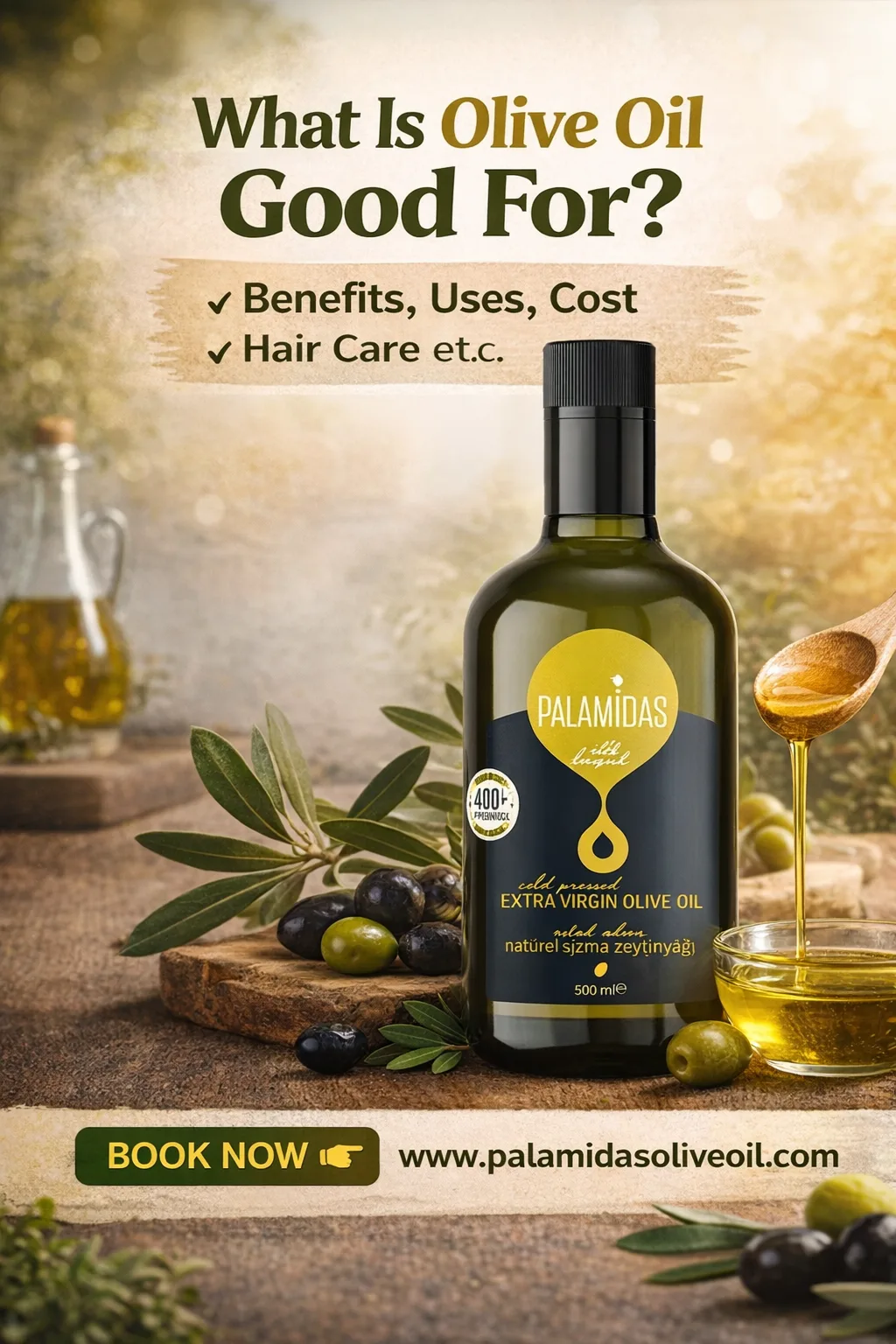
What Is Olive Oil Good For? Explained: Benefits, Uses, Cost Hair Care
Olive oil is a natural product that has been utilized over the centuries in health, beauty, and cooking. It is currently being highly prescribed by nutritionists and health enthusiasts due to its strong antioxidants and beneficial fats. But, what is good about olive oil, and is it worth the money? We will discuss in this Guide on Palamidas Olive Oil the health benefits of olive oil, the daily use of olive oil, benefits on hair care and whether olive oil is expensive or worth the money. What Is Olive Oil Good For? The most commonly known benefits of olive oil are that it helps in maintaining heart, digestion, skin health, and well-being. Extra virgin olive oil of good quality has monounsaturated fats, polyphenols, and vitamin E, which prevent the body against inflammation and oxidative stress. Key uses of olive oil include: Purity and traditional techniques of extraction are the points on which we emphasize and preserve these advantages at Palamidas Olive Oil. Read More – 7 Health Benefits of Extra Virgin Olive Oil Health Benefits of Olive Oil Supports Heart Health Olive oil is full of oleic acid, which is a healthy fatty acid that helps to lower the bad cholesterol (LDL) and retain the good cholesterol (HDL). The regular intake can reduce heart disease and high blood pressure. Improves Digestion Olive oil assists in the stimulation of digestive enzymes and the body becomes easy in taking nutrients. It can also make the gut healthy and less acidic. Anti-Inflammatory Properties Polyphenol is a natural antioxidant that combats inflammation known to cause chronic diseases such as arthritis and diabetes. Supports Brain Health Research indicates that olive oil use can serve to prevent cognitive impairment and lower the chances of old age memory impairment. Advantages to Drinking Olive Oil Before Bed Small portions of olive oil are now common as a wellness trend before bedtime. Potential benefits include: Experts suggest 1 teaspoon of extra virgin olive oil; best taken on an empty stomach. Premium product such as Palamidas Olive Oil can be used to get the highest level of nutritional value. Is Olive Oil Costly? The question that many people ask is, is olive oil cheaper than other oils Although refined and blended oils are cheaper it is not comparable to pure extra virgin olive oil as far as health is concerned. When you buy Palamidas Olive Oil you are buying a brand which you do trust and which has a taste and a long-term health benefit. In summary: olive oil of high quality might be expensive at first sight, yet it is more cost-efficient in terms of health and wellness. Read More – Why is palamidas the best cooking olive oil? Is Olive Oil Good for Hair? Olive oil is actually good on hair and scalp. How to Use Olive Oil for Hair It is important to use natural and high quality oil such as Palamidas Olive Oil to help it soak up and show results. Everyday Uses of Olive Oil Olive oil is a very multi-purpose product: This renders olive oil a vital daily requirement, and not a kitchen staple Why Choose Palamidas Olive Oil? Quality is the first at Palamidas Olive Oil. Our olive oil is: Whether you’re using olive oil for health, hair care, or daily cooking, choosing the right brand makes all the difference. FAQs – Regarding Olive Oil Q1. Can I consume olive oil daily? Yes, 12 tablets a day is usually said to be safe and beneficial. Q2. Is olive oil safe for cooking? Extra virgin olive oil can be used at low to medium-heat cooking. Q3. Is olive oil beneficial in weight loss? It could aid in weight control by enhancing metabolism and decreasing intake of unhealthy fat. Q4. Is olive oil applicable in all types of hair? Yes, however it should be used in less amount by people with oily hair. Q5. But what is the most health-promoting olive oil? The best one is extra virgin olive oil of a reputed brand as the Palamidas Olive Oil.
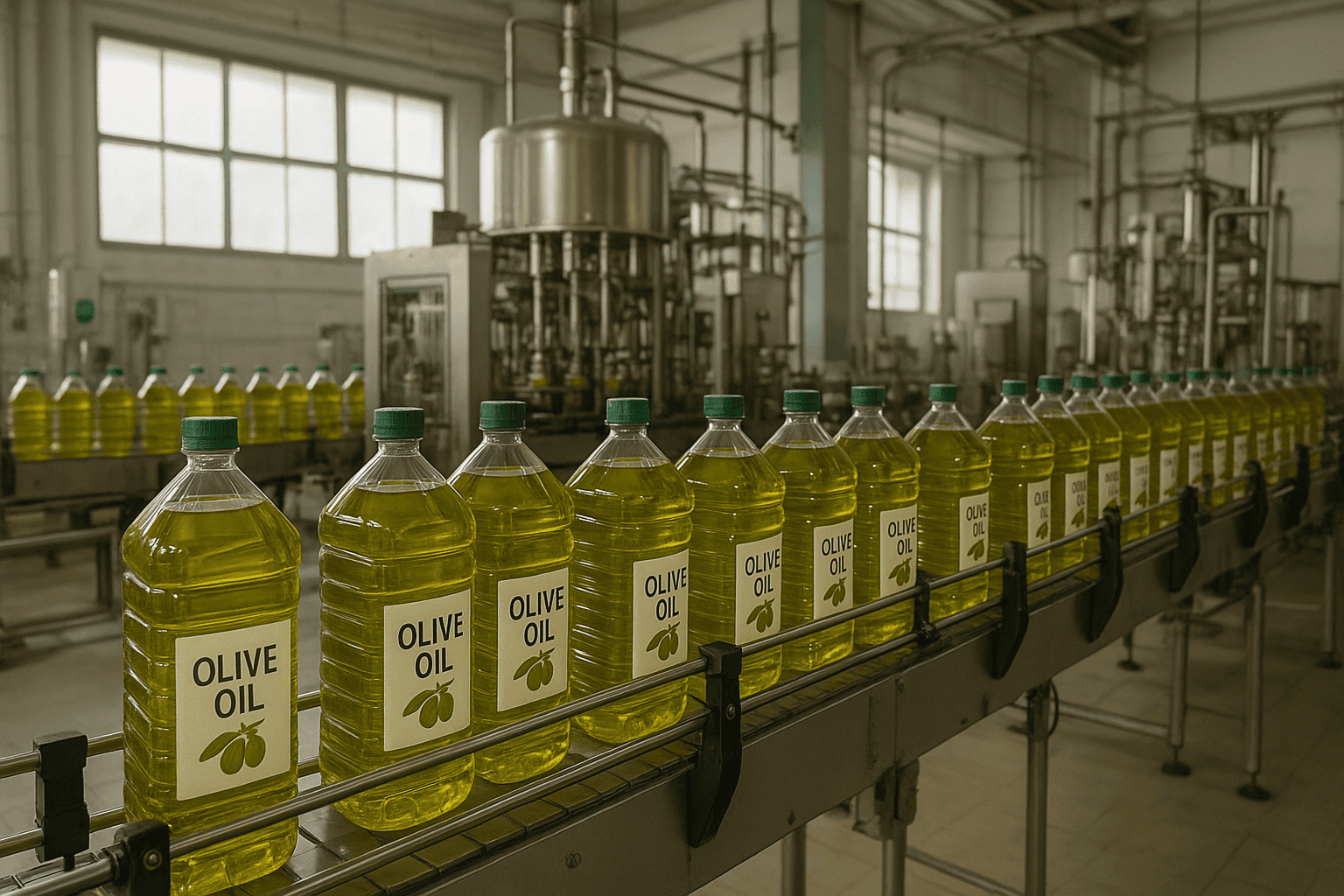
How Our Olive Oil Factory Meets International Export Standards
At Palamidas Olive Oil, quality is not just a promise—it is a process followed at every stage of production. From olive harvesting to final packaging, our olive oil factory operates under strict international export standards to ensure purity, safety, and exceptional taste for global markets. This commitment allows us to deliver premium olive oil that meets the expectations of distributors, retailers, and consumers worldwide. Carefully Selected Olives from Trusted Growers Our journey begins with sourcing olives from carefully selected farms known for sustainable cultivation and optimal soil conditions. Only healthy, perfectly ripened olives are chosen to maintain high oil quality and nutritional value. This selection process ensures consistency and compliance with international food safety standards. Modern Processing with Advanced Technology Palamidas Olive Oil uses state-of-the-art extraction technology to preserve natural antioxidants, aroma, and flavor. Our factory follows cold-press extraction methods, maintaining controlled temperatures to protect the oil’s quality. All machinery is regularly inspected, cleaned, and calibrated to meet international hygiene and operational standards. Strict Quality Control and Testing Quality checks are performed at every production stage. Our olive oil undergoes laboratory testing for acidity levels, purity, and chemical composition to ensure compliance with international export regulations. These tests guarantee that our products meet globally accepted standards for extra virgin and premium olive oils. International Food Safety Certifications Our factory adheres to globally recognized food safety and quality systems such as HACCP and ISO-based procedures. These systems help us maintain traceability, hygiene, and risk control throughout production. Compliance with these certifications allows Palamidas Olive Oil to export confidently to multiple international markets. Hygienic Packaging and Labeling Compliance Packaging plays a crucial role in maintaining olive oil quality during transportation. We use food-grade, export-approved packaging that protects the oil from light, air, and contamination. Our labeling complies with international regulations, providing clear information on origin, quality grade, nutritional values, and shelf life. Efficient Storage and Export Logistics Our warehouse facilities are temperature-controlled to preserve freshness before dispatch. We follow strict inventory management and export documentation procedures, ensuring smooth customs clearance and timely delivery to global destinations. Commitment to Sustainability and Global Trust Beyond quality and compliance, Palamidas Olive Oil is committed to environmentally responsible practices. Sustainable sourcing, minimal waste, and energy-efficient operations strengthen our reputation as a reliable international exporter. Conclusion Meeting international export standards requires discipline, transparency, and continuous improvement. At Palamidas Olive Oil, every step—from grove to global shipment—is designed to deliver premium olive oil that meets worldwide expectations. Our dedication to quality, safety, and compliance ensures that customers across the globe receive olive oil they can trust.